

New Year, New State’s Attorney, Higher Jail Population in Cook County
Written by Julian D. Cohen, Brown University, and Kamiryn Braxton Grimes, University of Chicago.
Under Cook County’s new State’s Attorney, Eileen O’Neill Burke, who assumed office in December of 2024, the county has experienced a substantial rise in its jail population. In just the first six months of her tenure, there was a 70% increase in the number of petitions for pretrial detention compared to the same period in 2024, even as arrest numbers have held steady. To make matters worse, the rate at which people are being detained pretrial has nearly doubled. As a result, the Cook County Jail population has seen an 11% spike, meaning 558 additional people have been punitively stripped of their freedom, torn from their families before any finding of guilt, and held without any evidence that doing so makes the surrounding community safer.
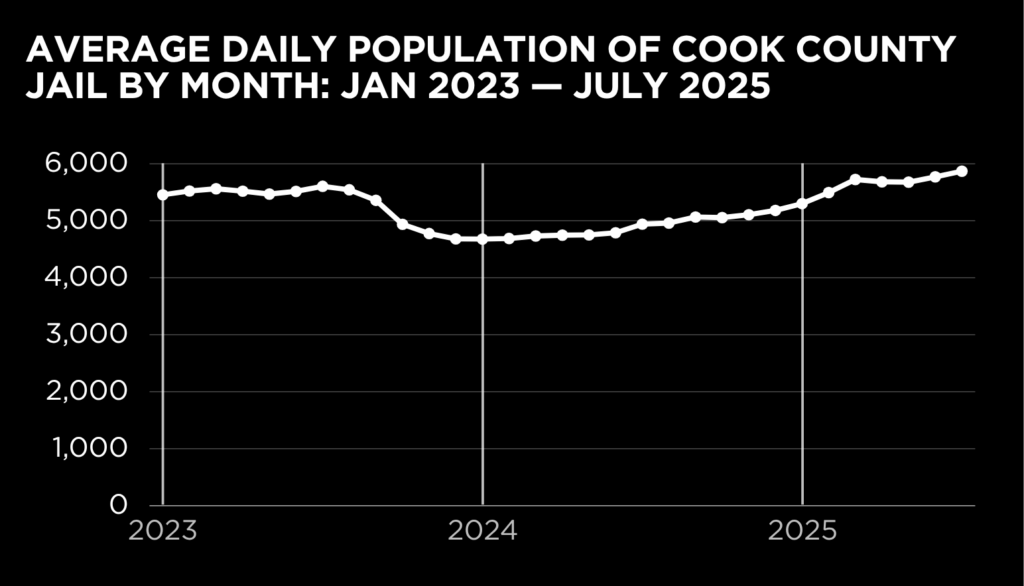
Community advocates highlight two major shifts under O’Neill Burke that explain the recent rise in the jail population. First, she dramatically expanded the number of types of shoplifting cases—the most common indexable case type in 2024—that her office would file as felonies, making them eligible for detention. Unlike her predecessor, Kim Foxx, who required at least $1,000 worth of goods to be stolen to pursue felony charges, Burke lowered the threshold to $300. According to a March 2025 research report by the Cook County Sheriff’s Office, obtained through the FOIA by Chicago Appleseed, charges for retail theft have contributed to a 24% increase in admissions to the Cook County Department of Corrections since November 2024. Because retail theft charges alone aren’t eligible for pretrial detention, it is likely that something else has led these people to be incarcerated (i.e., additional concurring charges or revocations of release for other pending charges). Unfortunately, the lack of clear data from the CCSO prevents us from drawing conclusions other than that these admissions likely stem from State’s Attorney O’Neill Burke’s decision to reduce the bar for felony prosecution, which appears to have led to more felony filings and pretrial detention petitions.
Second, Burke has instituted a blanket policy requiring prosecutors to seek pretrial detention in all firearm cases where certain factors are present, regardless of case-specific facts or evidence suggesting a low likelihood of rearrest or failure to appear in court. Prosecutors have also been instructed to object in every case where a judge denies their petition to detain and instead opts to release the accused person on electronic monitoring, effectively attempting to pressure judges into incarcerating more individuals. Pair these factors with the fact that Cook County is one of the slowest jurisdictions to take cases to trial—with a median length of 22 months—and you have a recipe for a climb in jail occupancy.
Another possible driver of the growing number of pretrial detention hearings and resulting surge in the jail population is Eileen O’Neill Burke’s Felony Review Bypass Program, which allows the Chicago Police Department to bypass the prosecutorial review process and independently file charges in low-level felony gun possession cases. By granting lieutenants the ability to bring felony charges—authority previously reserved for Assistant State’s Attorneys—the program removes a key layer of oversight intended to filter out weak or unsupported cases, prevent unnecessary detention, and limit strain on the court system. Notably, the police districts participating in the pilot are located in predominantly Black neighborhoods with longstanding histories of police misconduct.
O’Neill Burke has also announced that her office will no longer divert gun possession cases to the Restorative Justice Community Courts. Fewer individuals being diverted from the traditional court process for gun possession cases means that more people are either accepting plea deals or waiting months for their trials. Since nonviolent gun charges are a significant contributor to pretrial incarceration, with a 62% detention rate in the year following the abolition of money bond, many of these accused people are likely detained as they await their trials. Unfortunately, Chicago Appleseed’s fear that this shift would lead to an increase in pretrial incarceration is now playing out.
The impact of this indiscriminate, mass detention approach is grave. The individuals held in jail for years awaiting trial have their entire lives uprooted. Prolonged detention interferes with their ability to maintain employment, housing, educational enrollment, and access to mental health services. Many parents are separated from their children, leaving families unable to cover basic living expenses. Research shows that children with a parent incarcerated face seven and a half times the rate of food insecurity, alongside increased depression, lower educational attainment, and reduced opportunities for economic mobility. Such devastating consequences not only pressure individuals to accept plea deals, irrespective of their actual guilt, but also undermine the presumption of innocence within our criminal legal system. Even Cook County Sheriff Tom Dart has raised concerns about the growing jail population, which drives up costs paid for with taxpayer dollars and creates operational challenges.
All the while, this system does nothing to make us safer. In fact, pretrial incarceration has been linked to a greater likelihood of future arrest, even for individuals acquitted of their initial charges. And while the jail population continues to rise, the county has not seen a corresponding increase in crime. What remains clear is that the dire increase in pretrial detention only serves to destabilize our communities.
To address these challenges and the alarming growth in the jail population, we recommend:
- Raising the felony threshold for retail theft. This change would focus resources on more serious crimes and divert low-level offenders from disproportionate penalties.
- Eliminating the Felony Review Bypass Pilot, and encouraging Assistant State’s Attorneys to decline charges immediately after an arrest rather than wait months only to dismiss them anyway.
- Streamlining court case management to ensure timely case resolutions and reduce the number of people held in jail for extended periods before trial. It is important that this is done without foregoing due process for accused people.
- Prioritizing individualized case assessment that considers each defendant’s unique circumstances. Complex issues like gun possession cannot be addressed through a one-size-fits-all approach.
- Supporting efforts that bring transparency to the impact and implementation of O’Neill Burke’s new policies. Individuals interested in ensuring fairness during the pretrial process can get involved by volunteering with Chicago Appleseed’s court-watching program, which promotes accountability and ensures judges impose the least restrictive conditions.