
NEW Court-Watching Report – Evicted in the Dark: Findings & Observations from Cook County Eviction Courts
Chicago Appleseed is excited to announce the publication of Evicted in the Dark: Findings & Observations from Cook County Eviction Courts, our newest court-watching report!
The report, completed with support from our partners at the Chicago Foundation for Women, relies on findings from thousands of observations by our volunteer court-watchers who collected data in virtual initial appearances in Cook County eviction courts for all six districts between November 2024 and April 2025.
Eviction is an incredibly destabilizing experience because housing instability disrupts employment, education, childcare responsibilities, and people’s physical and mental health and well-being as well. An average of 7.6 million people in across the country—including 2.9 million children—faced eviction each year between 2007 and 2016. In Illinois, tens of thousands of Illinois families (approximately 1 in 25 renters) are threatened with eviction annually, and almost half the eviction cases filed throughout the state ultimately result in people losing their housing. For those who end up receiving an eviction order, it not only forces them to find a new place to live but leaves a lasting mark on their record, creating serious obstacles to securing housing in the future. In some cases, they are also required to pay a specified amount to resolve legal fees for the landlord.
We’ve been fighting to make eviction courts in Cook County more transparent and accessible for almost a decade and, in 2019, successfully advocated for Chicago’s eviction courtrooms to be equipped with court recording technology. Before this, records of eviction hearings weren’t being made, which made appealing an eviction orders nearly impossible for the estimated 80% of tenants without attorneys. For this project, we mobilized community volunteers from our Court Observation & Education Program (COEP) to witness eviction court proceedings firsthand with the goals to build on our past work and understand what’s actually happening in Cook County’s eviction courts today.
Our report identifies four major challenges our court-watchers observed in Cook County eviction courts:
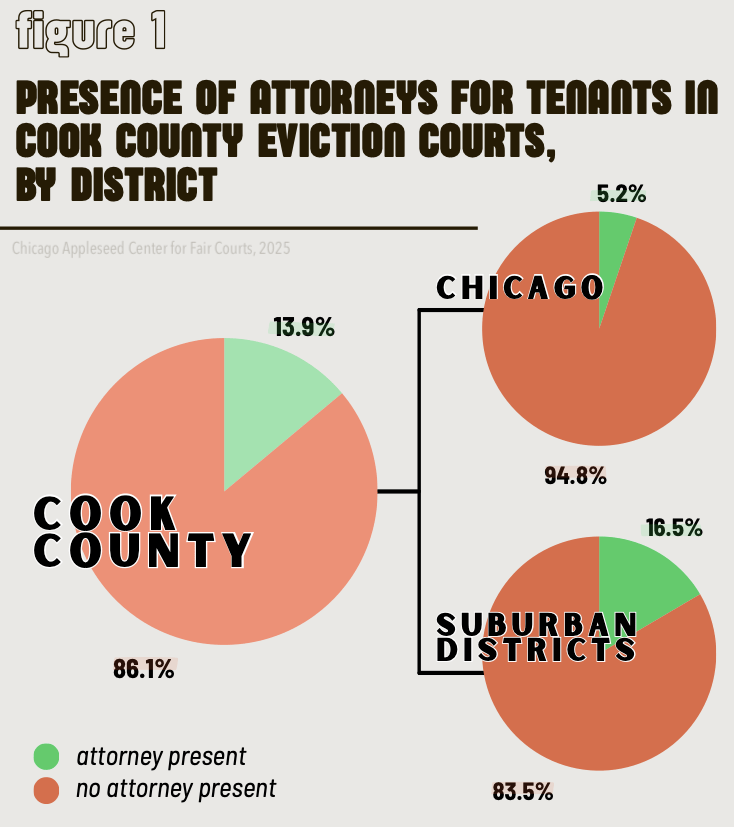
- Most tenants don’t have legal representation. In the initial appearance hearings observed by our court-watchers, a total of 86.1% of tenants were self-represented. This poses a serious disadvantage, as legal representation significantly reduces the likelihood of eviction.
- Black people are disproportionately represented in eviction hearings, accounting for less than 23% of the population of Cook County but almost 51% of tenants in eviction courts.
- Eviction proceedings are overly complex, fast-paced, and inaccessible to tenants. Heavy reliance on legal jargon and assumed familiarity with court procedures confuses individuals and limits their ability to participate in their own cases. Technological difficulties further hinder tenants’ ability to participate.
- Courts fail to consistently provide interpreters and ensure language access during hearings. In some cases, tenants are told to provide their own interpreters, while in others, court officials rely on machine translators, which are particularly unreliable in legal contexts. Without a qualified interpreter, self-represented litigants are left uncertain about the status of their case and what is required of them.
Many of the issues we observed were far worse in Chicago’s eviction courtrooms than in the suburbs, for instance:
- Nearly all tenants were without legal representation, with almost 95% of people representing themselves in initial appearance hearings observed by our court-watchers.
- Black renters accounted for 71% of of the people we observed in eviction hearings, with Black women and feminine-presenting people making up roughly half of these tenants, despite comprising only 17% of the city’s population.
These findings make clear that Cook County eviction courts are far from fair or accessible for tenants—who are overwhelming Black and Latine people without legal representation—and that the Circuit Court of Cook County, as it currently operates, is failing to help level the playing field.
Cook County and the City of Chicago have implemented some pilot programs to address these issues, but these programs don’t nearly go far enough. From the lack of legal representation to the overwhelming pace of hearings and inconsistent language accommodations, the system places significant burdens on renters attempting to navigate an already stressful situation. Addressing these shortcomings will require comprehensive reforms aimed at ensuring that all tenants have a meaningful say in the decisions that profoundly impact their lives.
You can find our report, Evicted in the Dark: Findings & Observations from Cook County Eviction Courts, here.
Special thanks to Austin Segal and Elizabeth Monkus, co-authors of the report; Patrick Reyna, Julian Cohen, and Kamiryn Braxton Grimes who helped with research; and Michelle Gilbert and Kiara Hardin for additional support throughout this project. Above all, we’d like to acknowledge our volunteer court-watchers who collected data and, in many ways, showed us where to look.
Blog post written by Julian D. Cohen and Stephanie Agnew.