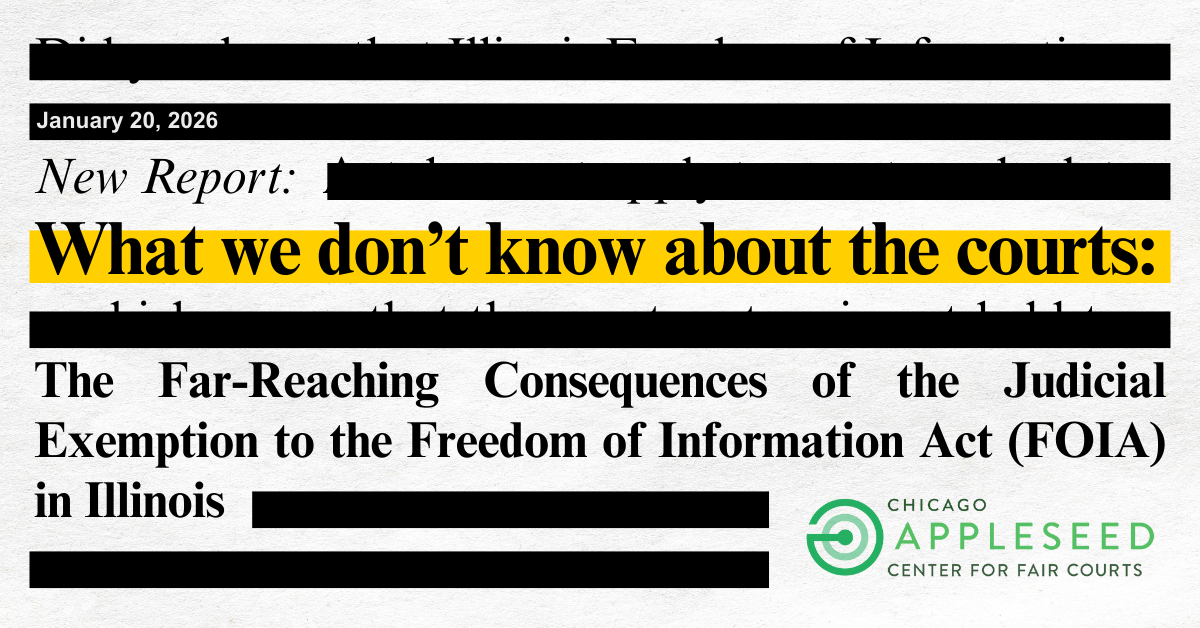
NEW REPORT—What We Don’t Know About the Courts: The Far-Reaching Consequences of the Judicial Exemption to the FOIA in Illinois
In our newly published report, What We Don’t Know About the Courts: The Far-Reaching Consequences of the Judicial Exemption to the FOIA in Illinois, Chicago Appleseed explains the judicial exemption from Illinois’ Freedom of Information Act (FOIA) and this exemption’s broad consequences for data transparency, research, and advocacy.
Illinois’ FOIA is modeled on the federal law of the same name and made Illinois the last state to implement such a law in 1984. Illinois’ FOIA requires public bodies—which encompass most government offices and officials—to respond to any written request for information within five days, unless they ask for an extension or show that the information is exempt from disclosure.
In 1995, an appellate court decided that, because Illinois’ FOIA does not explicitly name the judicial branch, the law was not intended to apply to the judiciary. In most other states where the FOIA does not extend to the judiciary, a court rule or another law requires disclosure of requested information by the judiciary. However, no such rule or law exists in Illinois. This means that the courts, their judges, and related offices are not held to the same level of transparency as other government agencies and officials—making Illinois one of only six states where this is the case.
This judicial exemption makes Illinois a national outlier. In fact, Illinois is one of only six states that does not require the judiciary to disclose requested information through either a Freedom of Information Act, another open records law, or a court rule.
What We Don’t Know About the Courts, page 3
This judicial exemption has a wider scope than you might imagine. Not only are judges exempt from the FOIA, but also offices overseen by a chief judge, which include many pretrial, diversionary, and probationary programs, as well as juvenile detention centers. Clerk’s offices and most public defender’s offices are also exempt from the FOIA as court-adjacent entities. This means that the public can’t access information on the number and average length of criminal and civil court cases, total court costs and fees, judicial assignments and performance measures, utilization of court services such as interpreters, management of electronic monitoring programs and diversion programs, juvenile detention conditions, use of public funds by the courts, or general court operations.
In the report, we present multiple avenues for reform. The simplest would be to pass an amendment to the FOIA that adds the “judicial branch” to the definition of “public bodies,” as has been proposed in HB 4395 and SB 1826 (fact sheet). Alternatively, a public records law could be passed to supplement the FOIA, as multiple other states have done. Finally, in the absence of these reforms, steps should be taken to increase compliance with existing reporting requirements, including creating enforcement mechanisms and working with the courts to identify barriers to compliance.
Part of Chicago Appleseed’s mission is to improve access to information about the legal system so that the public can effectively engage with stakeholders and hold them accountable. Over the years, we’ve advocated for transparency in many forms, including as a member of the Court Transparency Coalition (CTC), a diverse group of organizations across Chicago and Illinois who believe that the judicial branch should be subject to Illinois’ FOIA. Reach out to us if you would like to learn how to get your organization can involved!