NEW REPORT — 500 Days Forward, 10 Years Back: An Evaluation of Eileen O’Neill Burke’s First 500 Days as Cook County State’s Attorney
Chicago Appleseed has been following, researching, and reporting on the Cook County State’s Attorney’s Office (CCSAO) for over a decade. In our new report, 500 Days Later…10 Years Back: An Evaluation of Eileen O’Neill Burke’s First 500 Days as Cook County State’s Attorney, we present a comprehensive evaluation of the Burke administration’s policies and provide recommendations for the office. The report is based on analysis of the office’s policies, press releases and articles, conversations with the CCSAO and community partners, and quantitative data from various sources.
Key Findings:
- More people are getting felony records. Burke lowered the threshold for charging retail theft as a felony.
- More people are jailed pretrial. The jail population has increased to nearly 6,000 people due to the CCSAO’s practice of filing blanket detention petitions regardless of individual circumstances, which has been very consequential for gun possession cases.
- Law enforcement is given more power and less oversight. Burke allows the police to bypass felony review for gun possession cases, eliminates disclosure and do-not-call lists of police officers with a history of dishonesty or misconduct, shirks the responsibility of holding federal agents accountable for on-duty crimes, and makes it more difficult for people to find relief for wrongful convictions.
- Data access for researchers and the public has worsened. Burke eliminated the Felony Dashboard, which featured granular information about criminal cases, without publishing a meaningful replacement.
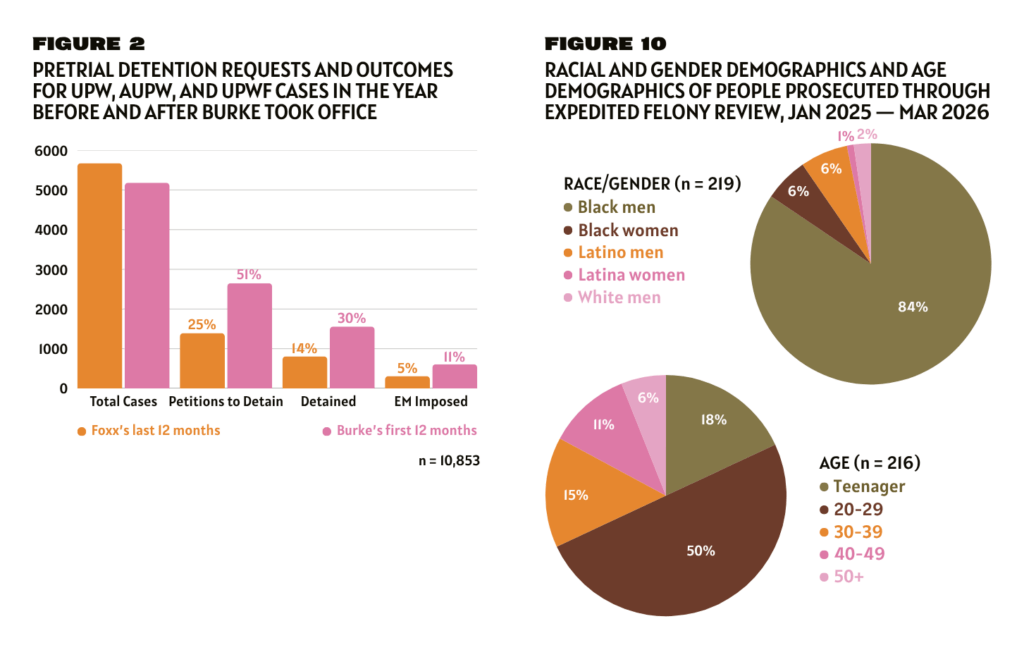
Prosecutors hold substantial power, with a hand in deciding what criminal charges to file, whether accused people are jailed pretrial, and what consequences they may face. Historically, prosecutorial offices have contributed greatly to mass incarceration, which has caused immense harm to low-income and Black communities. Burke’s predecessor Kim Foxx had a much more decarceral approach, meaning that many of her policies were intended to reduce the county’s usage of incarceration. In her first 500 days in office, Burke has shifted the CCSAO back toward aggressive prosecution and away from police accountability, which has already had harmful ramifications for the residents of Cook County.
We call on the Cook County community to help us advocate for the following changes from the CCSAO:
- Reinstate a higher charging threshold for felony retail theft.
- End blanket detention policies.
- Automatically divert eligible gun possession cases to diversion programs and expand eligibility to people of all ages.
- Reinstate felony review for gun possession charges.
- Reinstate disclosure and do-not-call lists.
- Investigate and prosecute federal agents for on-duty misconduct and illegal use of force.
- Accept CIU cases with pending post-conviction proceedings and stop objecting to certificates of innocence by default.
- Publish the Detention Dashboard as a downloadable data set.
- Collect and publish more case-level data.
Read the report at chicagoappleseed.org/Burke-500 to get more details about our findings and recommendations. We’ve made most of the records and data sets we analyzed public.
Want to share feedback on this report, ask a question, invite us to a teach-in in your neighborhood, or get involved in advocacy? Fill out this short interest form to let us know what you think and how we can collaborate with you on issues of prosecution and accountability in Cook County.