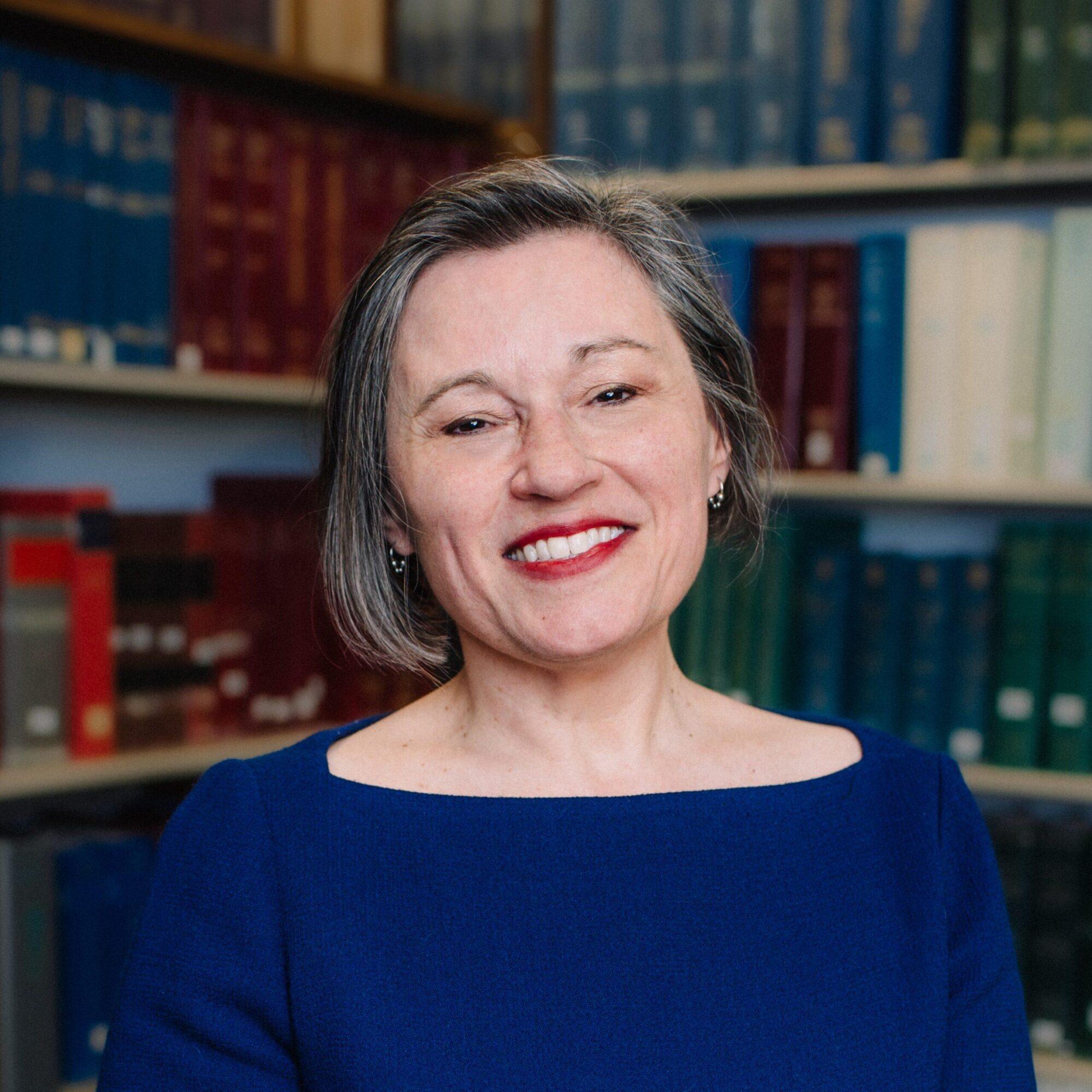
Elizabeth Monkus reflects on time with Chicago Appleseed
After 15 incredible years of dedication to Chicago Appleseed, we are saying goodbye to our beloved Elizabeth Monkus, Senior Attorney & Project Director, as she begins her retirement. Since Elizabeth joined the organization, she has shown amazing tenacity in her advocacy towards building a more fair court system. Before Elizabeth retired, we sat down for a conversation about her career and time with Chicago Appleseed.
The following conversation has been edited for length and clarity.
How did you come to be involved with Chicago Appleseed?
When I got back to Chicago, I was an appellate defender for a while, but I also was a volunteer with the Bloom Legal Clinic at Northwestern. In that context, I was involved in a couple of juvenile justice reforms that were going on in the early 2000s. When I went into private practice after leaving the appellate defender, I happened to have a case against Bob Slobig, who was general counsel for the Chicago Councill of Lawyers. We talked about that work that I had been doing at the Bloom Legal Clinic in juvenile justice, and he introduced me to Malcolm (Executive Director of Chicago Appleseed at the time). I was familiar with Chicago Appleseed and the Chicago Council of Lawyers, because they’re huge names in the public interest community of attorneys and legal professionals in Chicago. Chicago Appleseed had received funding to conduct a demonstration project to change how judges are evaluated for performance issues and retained in their seats. I did some work generally in elections, because in the early 2000s, we had an Illinois Supreme Court race that was at that time the most expensive judicial race that had ever happened in the United States. So that was where I started at Chicago Appleseed.
As that specific funding ran out and those projects kind of reached a natural pause, my work with Appleseed got bigger. And most of my work here has been in court regulation, court administration, and just the justice gap, really. I’ve done some criminal work, but most of my work at Chicago Appleseed has been either the courts generally, so touching both the criminal and the civil procedures, or been civil focused.
What were you looking forward to when you started working at Chicago Appleseed?
I was most excited to be putting my education and the skills that I had developed along the way towards something that not only was bigger than me or a client, but also was on the right side of things. You can be a practicing lawyer and on the right side of things. But that’s really hard to do as a practicing lawyer. As a researcher or in a similar role, you can focus solely on: how is this affecting the law as a whole?
When I came to Chicago Appleseed, I was able to put those skills and that education to work at a place that considered those larger goals first and was on the right side of the issues. It’s really amazing. I think I know the five people who have this job in the city of Chicago. I felt extremely lucky to have that opportunity to get this job that’s kind of something of a unicorn. And just be able to do good, solid work every day, and at the end of the day, not feel at all concerned about who I was working for or what the outcomes of what I was doing was going to be. It’s not to say that we don’t sometimes make mistakes or that there aren’t sometimes unintended consequences or that there aren’t failures. But it all fits into that larger context of: things have to be made better. And in the interim, we have to mitigate the harm as much as we can. And when I am not at work, when I’m out, with my friends or with strangers or alone in my own head, am I comfortable with the impact my work is having on not only the people I’m directly working for, but also for everybody who has no idea that I’m even doing this work? And I think Chicago Appleseed definitely took that kind of stuff into consideration, and it felt like a really solid place to work.
What’s been your greatest challenge in your role?
It’s being able to convince people that this is a valuable place and a meaningful place and an effective place to put their philanthropy, to put their charitable dollars. You know, direct services organizations can point to people and say this person is alive and healthy because of the work that we do. We can’t really do that. We can point to a broader class of people and say on the whole, women who need child support but can’t afford attorneys are doing better. But it’s really hard for us to find a single parent and say, you know, we went to bat for this parent and now they’re in a better place. Convincing people when all of our successes require an entire paragraph or an hour to explain why this was a success is really, really hard.
The less obvious challenges are also convincing people to work with you. It’s not hard to find partners, which is great. But judges are naturally skeptical when you come to them and say, I can help you. That’s always been a challenge: getting people to listen to you and let you in, so that you can get the information you need to help them. It’s sometimes a little difficult to accept that this person is on your side. The biggest challenges are always money and establishing that trust so that you can work with people who don’t think they need help, or who wouldn’t naturally see you as an ally.
What’s been your proudest achievement in your role?
The signature accomplishment of my time with Chicago Appleseed was the consolidation of the Domestic Relations Division and the change in how hearing officers functioned in that division. First, the division was clearly operating in a way that violated the equal protection rights of children whose parents had never been married to each other by treating them differently than children whose parents were once married or currently divorced or of a similar situation. They’d been sued in 1996 over it and the suit was dismissed because the court said they’d make changes. And they made some superficial changes, but 20 years later they were still operating in the same way that had brought the suit. We were able to convince the court to finally make the necessary changes so that all child support matters, and therefore all children in need of child support, were treated exactly the same way in Cook County. They have the same access to services, the same access to, sounds superficial, but they have the same access to the nice courtrooms. They have the same access to the childcare facilities, all that kind of stuff.
Part of what gets glossed over is how we worked with the division to change how they used hearing officers. Hearing officers are attorneys, and they are empowered to make certain findings of fact. They can look at people’s W-2’s and find, in the legal sense, what the parents’ incomes are. They can do small findings of fact, and then they can write a recommended order for the judge to enter in the case. It’s a very important role. It alleviates congestion in the courts and it also makes the process a lot calmer. It makes it a lot more accessible to the parents because the hearing officer can stop and explain what they are doing and why. Judges can also do that, but they’re not comfortable doing it because it’s hard to explain what you’re doing and why without getting into a conversation about who’s right and who’s wrong. And judges very understandably have a lot of work to do and they don’t have time. They also don’t want to be accused of helping one side over the other, right? Hearing officers have a little more latitude there. They have a little more time, they have fewer cases, and they have an approachability that a judge doesn’t have. It’s hard to explain our accomplishments succinctly, but we changed how the division employed those hearing officers. They can do a whole bunch of things now for the courts than they couldn’t before. Prior to the change, they could only establish paternity by DNA tests or a voluntary acknowledgement. They could set a child support order and they could locate a lost parent. After we made the changes, they could draft an actual divorce decree. They can handle what’s called a quadrille, which is important for distributing retirement funds after divorce. That significantly changed the speed with which cases go through domestic relations. It changed the number of times a person has to come back to court and talk about the broader view of things.
If that is all it had done, it would be a really big thing. But it also helped us convince the courts in other places that the court is allowed to do more for the people who come in without attorneys. Court-based legal services don’t have to be as restrictive as they currently are. And we aren’t there yet. We still don’t have good court-based legal services in Cook County, but we have a bunch of judges who are thinking about it differently, and that’s the first step in getting it changed.
Could you share a favorite Chicago Appleseed memory?
My favorite moments from Chicago Appleseed are being out in the world and discovering the people who know who we are. A friend of mine, her sister runs group rides and all this cycling stuff. I ran into her at a bar once and she said, you know what, I need to donate to you because you do this thing. I was like, you are a person I would never have thought was even aware of the court reform community! And she was. That has happened more than once. I’ve run across people who weren’t connected to the legal profession, but were familiar with Chicago Appleseed.
It’s always been kind of a thrill when people in either the reform community or in the profession who do recognize the name Chicago Appleseed can pin it to something that we did. We don’t get a lot of feedback when our projects are done. We get the direct feedback from whomever we were helping, or we get the direct feedback from whoever was helping us. I’ve run into people who are connected to the courts, who are aware of what we have done and how it has helped. And I think that’s definitely a favorite memory.
What are you most looking forward to in your retirement?
Immediately, I’m looking forward to taking a big rest. I’m going to hang out at the pool at my sister’s building and do nothing. But I think most of what I’m looking forward to is being able to really pick and choose what I dedicate my time to and just be really thoughtful about what volunteering I’m going to do or what advocacy I’m going to do, and actually having the time to prioritize it. I used to do Cabrini Green Legal Aid’s Expungement Help Desk. And I loved it. Most of the people I helped were young folks who were wrapping up the schooling they needed to become nurses or physician assistants. And they couldn’t take their licensing exam because they had, you know, some dumb shoplifting arrest that didn’t go anywhere. So I would help them get their records clear and then they would go and they’d get their license. And that was extremely rewarding. But then the hours with that clinic started to conflict with a standing meeting I had and I couldn’t do it. So that’s not going to happen anymore. I will be able to pick and choose and schedule my stuff around whatever volunteering or activism I keep doing. And that’s going to be really great. I’m really looking forward to that.