

The Pretrial Fairness Act: Explained
Written by Austin Segal and Kate Bannister.
Earlier this month, the Illinois Network for Pretrial Justice published a court-watching report titled Changing Landscapes: Community Court-Watchers’ Observations of the Second Year of Pretrial Fairness Act Implementation. The report, in which Chicago Appleseed played a heavy role, highlights shifting trends in the implementation of the Pretrial Fairness Act and presents recommendations to better apply the law. This blog post supplements the report by offering a historical account of pretrial reform and a rigorous explanation of Illinois’ prior and current systems of pretrial detention.
INTRODUCTION
In January 2021, the Illinois General Assembly passed the Safety, Accountability, Fairness and Equity-Today (SAFE-T) Act. This criminal justice omnibus bill was drafted by the Illinois Legislative Black Caucus in response to years of organizing by the Illinois Network for Pretrial Justice and the 2020 Black Lives Matter protests. At the center of the SAFE-T Act were a series of reforms to Illinois’ pretrial system, collectively referred to as the Pretrial Fairness Act. Most notable among these reforms is the abolition of money bond, implemented statewide on September 18, 2023, which ensures that pretrial detention is no longer decided by an accused person’s ability to pay a money bond.
In recent decades, the United States has witnessed a dramatic increase in the use of pretrial detention: On any given day, nearly 450,000 Americans are awaiting trial in jails, which is a 300% increase since 1983. In this way, pretrial detention has more than kept up with the broader trend of mass incarceration over the same time period. The Pretrial Fairness Act addresses the issue of rising incarceration of non-convicted individuals through the elimination of money bond.
PRETRIAL DETENTION
Pretrial detention is the practice of incarcerating an accused person in a jail between their arrest and trial. During this period, accused people are still legally innocent, and pretrial detention is imposed with the purpose of mitigating risks of harm and ensuring an accused person’s appearance at future court dates. However, data shows that pretrial detention is ineffective, as it has been found to increase the likelihood of an accused person committing another offense before their trial and failing to appear in court.
Each state has its own legal framework for pretrial release which gives the criteria for who is and who is not legally eligible to be detained pretrial. At the first court appearance after someone’s arrest, the court determines the individual’s pretrial conditions, including conditions of release and setting bail.
If an accused person is released pretrial, a judge may impose conditions on their release. Pretrial conditions are intended to ensure a defendant’s appearance in court while protecting the safety of the community and other individuals. All defendants on pretrial release are required to attend all court proceedings and refrain from committing any criminal offenses. Additional conditions can include participation in drug, mental health, or other treatment programs; electronic home monitoring; house arrest; curfews; drug testing; prohibitions on possessing weapons or firearms; and any other conditions the court considers necessary to ensure appearance in court and protect public safety. In most cases, courts also impose financial conditions in the form of money bonds.
Pretrial services, established at federal, state, and local levels, assist defendants in managing their pretrial conditions. Additionally, pretrial service officers supervise defendants to make sure they abide by the conditions set. These officers also assist in gathering information for the judge to determine the defendant’s pretrial conditions, including community relationships, mental health or substance abuse history, etc.
If a defendant violates their conditions of pretrial release, it is possible for their pretrial release to then be revoked by the court. Revocation of pretrial release involves a defendant getting their pretrial release revoked, and being held in custody until their trial. Revocation can occur if the defendant has committed a new crime during their pretrial release or violated their conditions of release. If it is believed that either situation has occurred, the defendant is brought into custody, and a revocation hearing is held. At the hearing, the court determines whether pretrial release should continue based on the likelihood that the defendant will appear in court and whether they pose a risk of committing another offence while released.
WHAT IS MONEY BOND
Money bond (also known as cash bail) is a pretrial release system that requires a defendant to pay a set amount of money to secure release from custody, which is refunded upon compliance with court appearances and other pretrial conditions. Specifically, the money bond system only grants release to accused people before their trials if they are able to post bail, i.e., pay a money guarantee set by a judge. Judges determine the bail amount based on a range of factors, such as the type of offense alleged, criminal history, community ties, risk to the public, etc. The United States has employed a money bond system since its founding, though the policies governing its usage have varied across jurisdictions and time.
EFFECTS ON POOR POPULATIONS & BLACK AND BROWN POPULATIONS
Systems of pretrial detention based on money bond tend to detain poor people at incredibly disproportionate rates: The Prison Policy Initiative found that, nationally, more than 60% of people detained pretrial in 2015 were among the poorest third of the United States. A report published by the Open Society Justice Initiative illustrates this impact:
“Pretrial detention disproportionately affects individuals and families living in poverty: they are more likely to come into conflict with the criminal justice system, more likely to be detained awaiting trial, and less able to make bail or pay bribes for their release.”
Even a brief period of pretrial detention risks destabilizing an accused person’s employment, housing, and health, which is felt more pronouncedly if they are already low-income. A 2022 Federal Reserve survey showed that 37% of Americans lack enough money to cover a $400 emergency expense. This shows that even low bail amounts, under $500, can be enough to prevent people from posting bail.
Additionally, many laws criminalize behaviors tied with financial hardship. For example, most states impose restrictions on how individuals can use public spaces, including banning sleeping in these places and in parked cars. These laws put unhoused individuals at a greater risk of coming into conflict with the criminal justice system simply because they are unhoused.
Pretrial detention also poses racially disparate impacts, as Black and Brown accused people face higher rates of pretrial detention than White accused people on a national scale. Additionally, Black and Brown individuals are disproportionately represented in criminal systems compared to the United States population. Because of this, all issues within criminal systems inherently have heavier impacts on Black and Brown communities.
Due to the compounding injustices within our criminal system, there have been movements for decades to reform the system of pretrial detention and limit the use of money bond.
HISTORY OF PRETRIAL REFORM
FEDERAL REFORM
The United States bond reform movement was established in the 1960s. This movement led many jurisdictions to pass laws favoring pretrial release, setting limits on the value of money bonds, introducing the option of imposing conditions on an accused person’s release, and establishing pretrial services agencies.
1961 to 1962: The Manhattan Bail Project brought widespread attention to the pretrial bond system and demonstrated high likelihood of accused people appearing in court when released before their trial; various American cities replicated this New York City-based program, including Chicago.
1966: The Bail Reform Act of 1966 refined federal bail policy by limiting pretrial detention to cases where release would not “reasonably assure the appearance of the person as required.” Under the Act, individuals charged with non-capital offenses were generally entitled to pretrial release and restricted use of money bond unless there was reason to believe they would fail to appear in court.
1968: The American Bar Association called attention to the harmful nature of the money bond system, noting that it “causes discrimination against defendants and imposes personal hardship on them, [on] their families, and on the public.”
1974 and 1979: The Speedy Trial Act established time limits for different processes within federal prosecution and a 1979 amendment prevented defendants from being rushed to trial without adequate time and opportunity to prepare. Specifically, there should be 30 days between someone’s arrest and indictment, and 70 days between their indictment and trial.
1982: The Pretrial Services Act required pretrial services to be provided in all federal districts, with the exception of Washington, D.C. This act expanded previous “demonstration” pretrial services (i.e., the 10 judicial districts selected to collect data on the effect of pretrial services) and allowed each court to establish pretrial services based on its needs.
1984: The Bail Reform Act of 1984 called for judges to release defendants if the court has the ability to establish pretrial conditions that “reasonably assure” a defendant’s future appearance in court and additionally, protect the safety of individuals and the community.
1992: Washington D.C.’s Bail Reform Act of 1992 ended the imposition of money bond amounts that resulted in detention and required that judges decide on the least restrictive conditions that would ensure an accused person’s appearance in court and the safety of others. Other jurisdictions—such as Kentucky, New Jersey, New Mexico, and Maryland—have since implemented policies to reduce the number of people detained pretrial and promote fairness in this process.
HISTORY OF PRETRIAL REFORM IN ILLINOIS
The movement to abolish money bond in Illinois began in earnest in 2016 with the founding of the Coalition to End Money Bond by Chicago Appleseed, the Chicago Community Bond Fund, and several other local organizations. Over the years, this group of organizations, policy experts, and advocates aligned efforts to abolish the money bond system in Cook County, yielding various incremental reforms that reduced the harm of the pretrial system to achieve that goal.
2017: The Coalition to End Money Bond successfully advocated for General Order No. 18.8A, which required Cook County judges to set money bonds at amounts accused people could reasonably pay and ultimately reduced the Cook County Jail population. However, court-watching conducted by the Coalition to End Money Bond showed that compliance varied significantly within courts and judges. Additionally, overall trends showed that jail populations decreased during this time.
2019: The Coalition to End Money Bond expanded statewide to become the Illinois Network for Pretrial Justice, uniting more than 40 organizations across the state under a collective organizing strategy.
2021: The Safety, Accountability, Fairness and Equity-Today (SAFE-T) Act was signed into law. Years of research and advocacy resulted in the passage of the SAFE-T Act, inclusive of the Pretrial Fairness Act which ended money bond altogether in Illinois, replacing it with a system where an accused person’s ability to pay is never a factor in their pretrial release.
2023: The Pretrial Fairness Act was implemented in its entirety. Because of a then-pending case in the Illinois Supreme Court, the abolition of money bond did not occur in January 2023 as planned and was delayed to September 18, 2023.
PRETRIAL DETENTION IN ILLINOIS BEFORE THE PRETRIAL FAIRNESS ACT
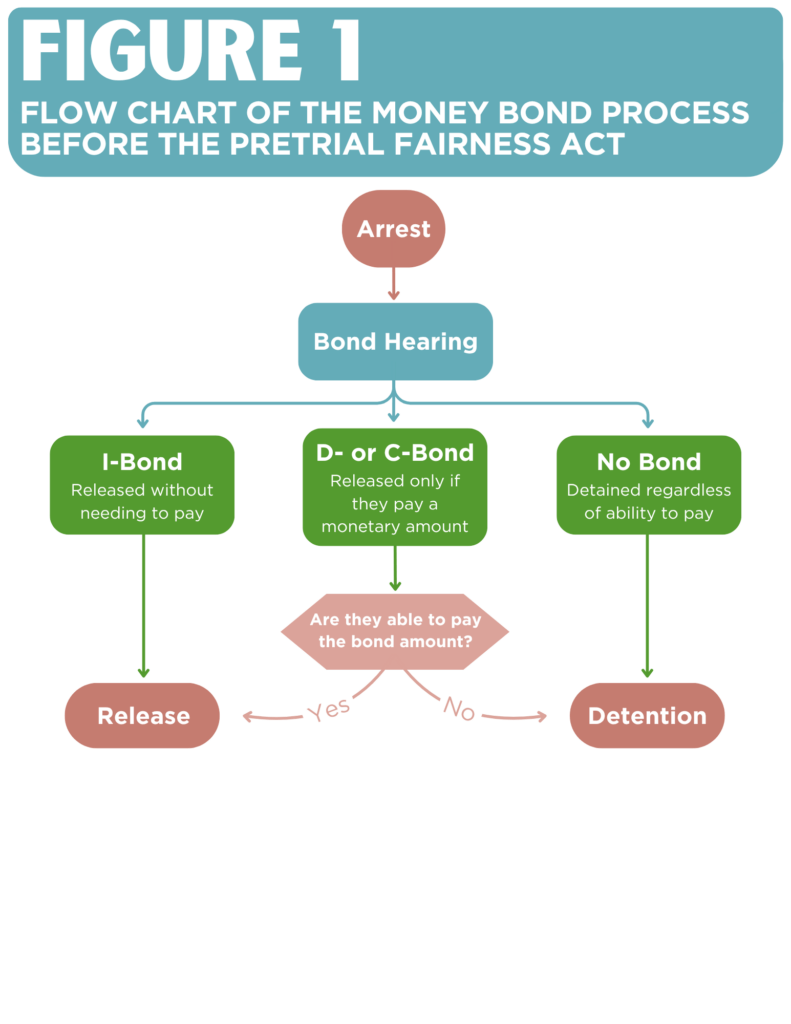
Until the Act’s implementation in September 2023, Illinois employed a traditional money bond system to determine pretrial release. If law enforcement arrested someone for an alleged criminal offense, the accused person would most often have a bond hearing within 24 to 72 hours, though sometimes longer. At their bond hearing, which typically lasted only a few minutes or less, they would receive one of the following decisions:
- I-Bond (individual recognizance bond): They were released before their trial without needing to pay a money bond.
- D-Bond (deposit bond): They were released before their trial upon paying 10% of their money bond amount.
- C-Bond (cash bond): They were released before their trial upon paying the entirety of their money bond amount.
- No Bond: They were detained before their trial without the option to pay a money bond.
Note that I-Bonds resulted in pretrial release, No Bond holds resulted in pretrial detention, and the results of D- or C-Bonds depended on an accused person’s or their community’s ability to pay a specified amount. Bond decisions could also be paired with pretrial conditions, such as pretrial supervision, protective orders, or electronic monitoring. See Figure 1 for a visualization of the money bond process.
PRETRIAL DETENTION IN ILLINOIS UNDER THE PRETRIAL FAIRNESS ACT
Under the Pretrial Fairness Act, whether an accused person is detained pretrial never depends on their ability to pay a money bond. A state’s attorney’s office (“the State”) may only petition to detain someone pretrial if they have charged them with a detention-eligible offense and allege that either their release would pose “a real and present threat” to a person or the community or they have “a high likelihood of willful flight to avoid prosecution.”
The Pretrial Fairness Act defines willful flight explicitly as “intentional conduct with a purpose to thwart the judicial process to avoid prosecution.” The statute makes clear that isolated instances of nonappearance in court do not alone indicate risk of willful flight and may not be used at all as evidence in this regard if the accused person then appears in response to a summons. Patterns of intentional evasion of prosecution, however, may serve as evidence that there is risk of willful flight.
The Pretrial Fairness Act states that any of the following factors about an accused person may be considered in determining “dangerousness” or demonstrating “a real and present threat”:
- The alleged offense and the circumstances surrounding it
- The accused person’s criminal or psychiatric history
- Statements the accused person has made
- The accused person’s age
- The accused person’s potential access to weapons
- Whether the accused person was on probation or other supervised release at the time of the alleged offense or arrest
- Information about victims or individuals who might be at risk
- “Any other factors . . . deemed by the court to have a reasonable bearing” on the accused person’s behavior
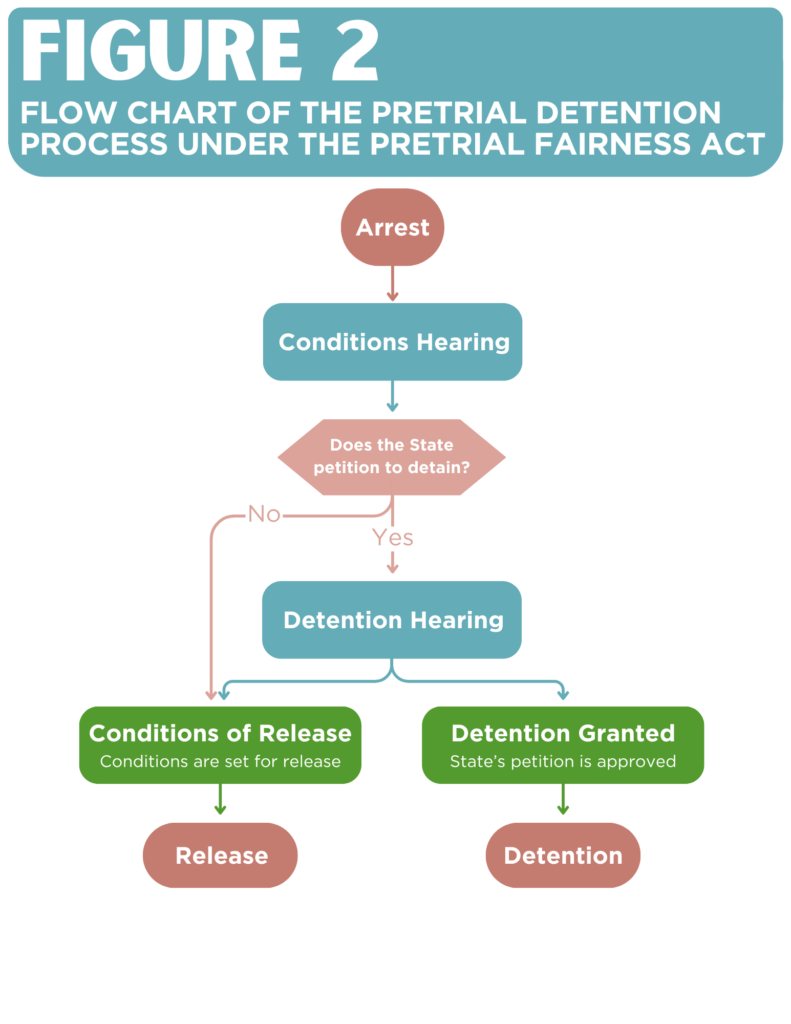
When someone is arrested for an alleged criminal offense, they appear at a conditions (of release) hearing. If the State does not file a petition to detain them, a judge hears arguments from the State and defense and imposes what they determine to be the least restrictive conditions necessary to ensure the accused person’s continued appearance in court and the safety of any person or the community. Any discretionary pretrial conditions are imposed alongside the standard conditions: that the accused person appear in court, follow court orders, and, for certain charges, surrender their firearms and submit to a psychological evaluation.
If the State does file a petition to detain the accused person, they appear at a detention hearing. At this hearing, a judge hears arguments from the State and defense and decides whether the State showed that (1) the proof is evident that the accused person committed a detention-eligible offense, (2) they pose a safety threat to a person or the community or are likely to evade prosecution, and (3) no conditions of release could mitigate these risks. If the judge decides not to detain them, they instead impose the least restrictive conditions necessary to mitigate risks as they would in a conditions hearing.
The Pretrial Fairness Act and its trailer bills impose deadlines for first appearances and detention hearings. If an accused person is arrested for a detention-eligible offense, their first appearance before a judge must be held within 48 hours; this is typically a Gerstein hearing to determine probable cause. If they are released from custody without a detention hearing, the State has 21 days to file a petition to detain them. If they are in custody when the State files their petition, their detention hearing must be held “immediately”; at the very latest, it must be held within 24 hours of their first appearance for a misdemeanor or Class 4 felony, or within 48 hours for a greater offense. The Illinois Supreme Court decided in People v. Cooper (2025) that a court’s failure to hold a timely detention hearing does not automatically lead to dismissal of the petition to detain; in such a case, though, the accused person may be entitled to relief if they were prejudiced by the timeline violation.
In contrast to the four potential detention outcomes for someone awaiting trial under the money bond system, there are now only two, neither of which requires them to pay a money bond:
- Release: They are released before their trial as long as they follow their conditions of release.
- Detention: They are detained before their trial.
See Figure 2 for a visualization of the pretrial detention process under the Pretrial Fairness Act.
There are multiple opportunities for someone detained pretrial to be released later in the pretrial period. Judges are required to reconsider at every subsequent pretrial hearing whether detention is still necessary, and the accused person may only be detained if the judge continues to find it necessary. Moreover, no one may be detained for more than 90 days as they await trial unless the delay is due to continuances by the defense or with good cause by the State. We know from data and anecdotal evidence, however, that many criminal cases last longer than 90 days in Illinois. In Cook County, for example, the median length of a felony case that went to trial in the first ten months of 2024 was 20 months, and only 2% of these cases were resolved within 90 days.
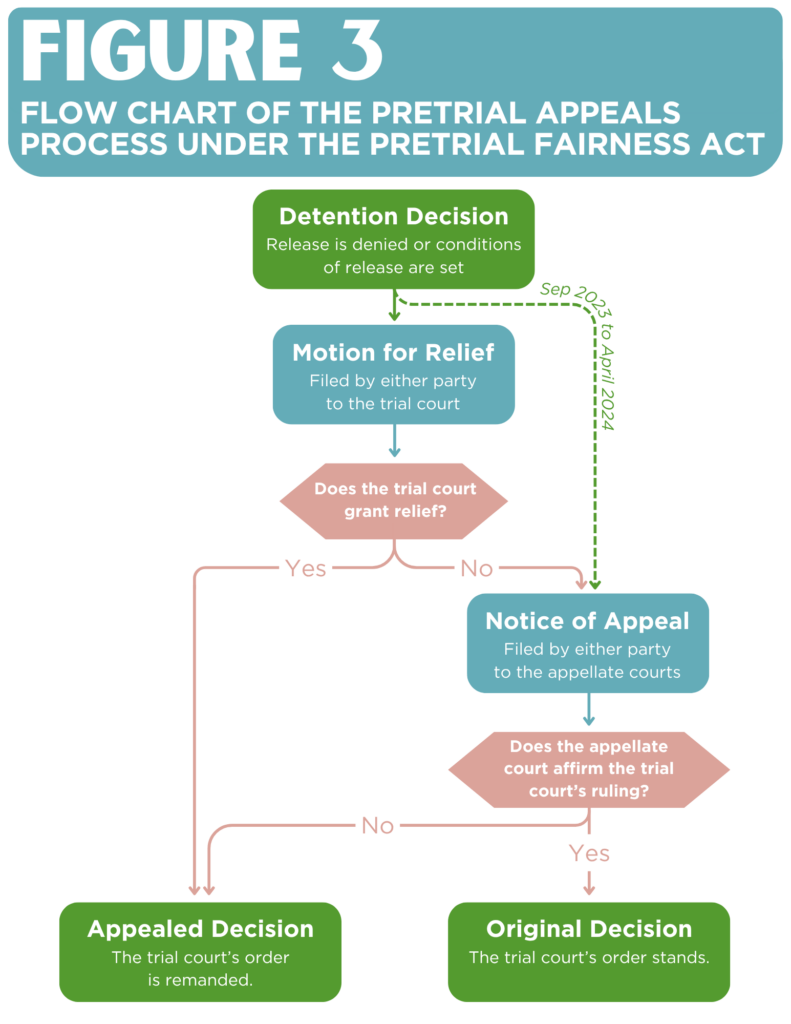
Both the defense and the State have a right to appeal any decision regarding conditions of pretrial release, pretrial detention, or revocation of pretrial release. The appeals process has changed since the implementation of the Pretrial Fairness Act. Until April 15, 2024, either party could appeal by filing a notice of appeal within 14 days of the decision. However, this quickly proved overwhelming for the appellate courts: In the first few months after the Pretrial Fairness Act was implemented, the number of appeals statewide increased from 17 per year to 380 per month.
To deal with this massive shift, the Illinois Supreme Court amended Rule 604(h) to add an additional step before an appeal, extend the time frame for an appeal, and adjust the evidence needed for an appeal. Rule 604(h) now requires that the defense or prosecution file a motion for relief in the trial court as a prerequisite to a notice of appeal. They may only file a notice of appeal if the trial court does not grant relief, and they may do so at any time before their case is disposed of. Only issues raised in the motion for relief may be argued in a subsequent appeal, and the appellant’s arguments—consisting of the motion for relief and an optional memorandum to supplement it—must include “sufficient detail to enable meaningful appellate review,” such as substantial evidence and proper citations. In theory, the appellate court must respond with a decision within 100 days once a notice is filed.
See Figure 3 for a visualization of the pretrial appeals process under the Pretrial Fairness Act, both before and after the April 2024 change.
CONCLUSION
The Pretrial Fairness Act is the result of years of advocacy by organizations across Illinois committed to expanding justice and reducing inequalities in our legal system. Through the elimination of money bond, the Pretrial Fairness Act removed a person’s financial circumstances as a determining factor in whether they are detained before their trial, thus reducing the number of people jailed pretrial. According to data collected one year after implementation, monthly average jail populations declined by 14% in urban counties and 25% in rural counties. Overall trends showed counties experienced their sharpest decline in incarceration levels immediately after the implementation. In 2025, levels still remained below pre-Act levels statewide; however, incarceration levels are trending upward. With the data, we recognize the Pretrial Fairness Act as an important step toward reducing the disproportionate burden that pretrial detention places on low-income communities and continue to push for additional support to create more equitable pretrial conditions.