
NEW—The Impact of the Pretrial Fairness Act on Electronic Monitoring in Cook County: Report
Today, Chicago Appleseed published a new report, The Impact of the Pretrial Fairness Act on Electronic Monitoring in Cook County, examining the impacts of the legislative reforms on Cook County’s pretrial electronic monitoring (EM) system.
These reforms, initiated as part of the Pretrial Fairness Act, include higher standards for risk to impose pretrial EM, guaranteed periods of essential movement, mandatory reviews of pretrial conditions every 60 days, a higher standard for escape charges, and guaranteed sentencing credit for convicted individuals who spent time on EM pretrial. Such measures aim to address the main harms experienced by those subject to EM. Read the full report here.
The use of electronic monitoring in Cook County has surged in recent years, reaching a peak of 5,000 participants in 2021 amidst the coronavirus pandemic. Often portrayed as an alternative to incarceration, EM in reality infringes on individuals’ privacy and expands the reach of incarceration and surveillance. It disproportionately impacts Black and Brown communities, is imposed on people who would otherwise face little to no restrictions, causes serious mental strain, and fails to meaningfully shrink jail populations.
To address these persistent challenges, the EM system in Cook County has undergone several overhauls. Most notably, the county is set to consolidate the program run by the Cook County Sheriff’s Office into the one administered by the Office of the Chief Judge in September of this year. While the report’s research was conducted prior to this consolidation, it still offers valuable context for understanding the implications of this forthcoming change.
Drawing on data from the Cook County Sheriff’s Office and interviews with former EM participants and attorneys, our researchers carried out an in-depth evaluation of the implementation and outcomes of the recent Pretrial Fairness Act EM reforms.
The findings reveal that the success of each reform varies considerably in practice. Some of the key takeaways include:
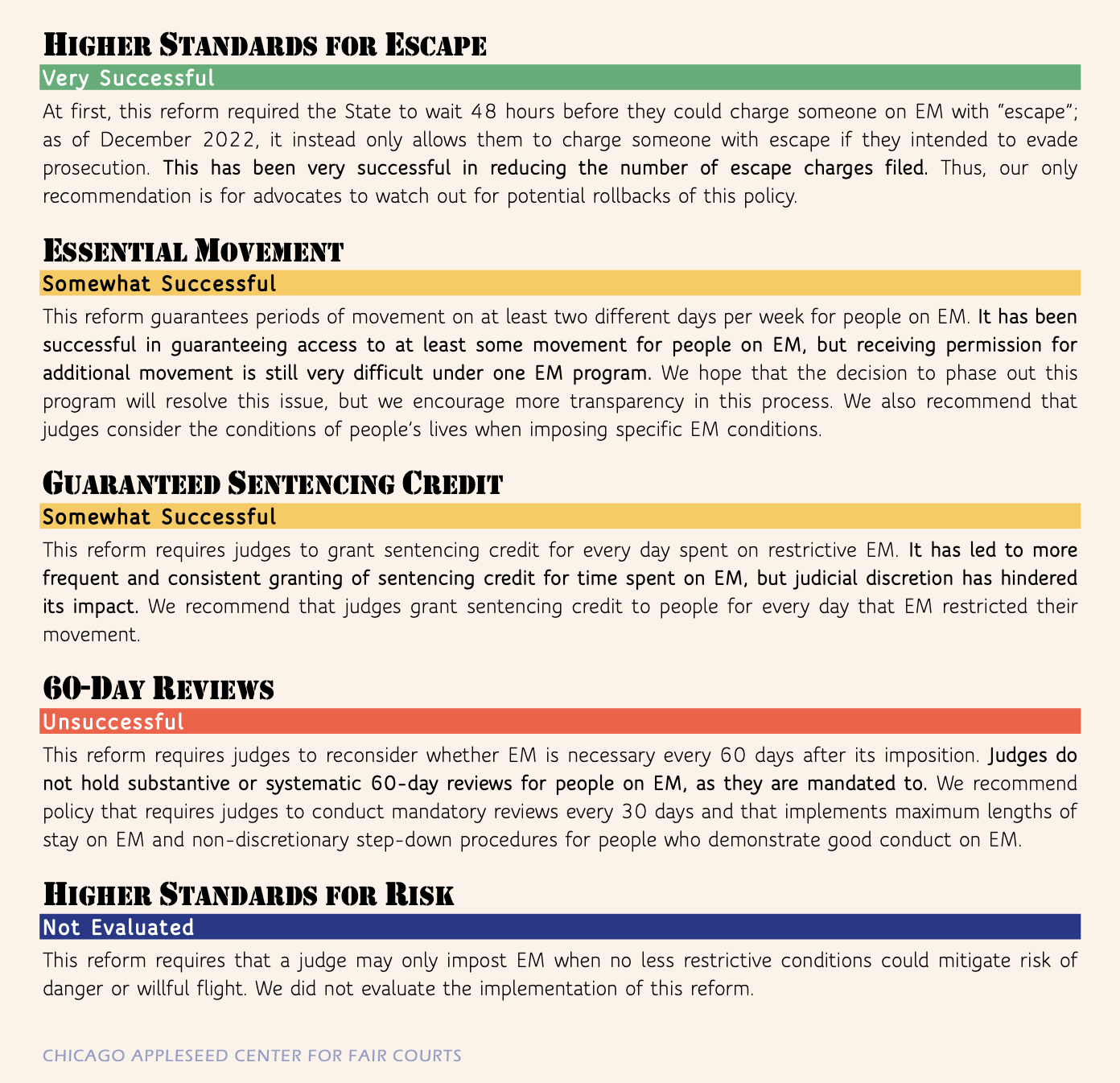
- Despite reforms allowing two guaranteed movement days to address previous restrictions that left people on electronic monitoring without essentials or reliant on limited support, access to additional movement remains difficult, and individual needs like work or caregiving are rarely considered in EM decisions.
- The mandatory 60-day reviews requiring judges to reconsider EM and assess less restrictive alternatives have proven ineffective. Judges rarely initiate reviews on their own and often treat them as mere formalities rather than meaningful hearings.
- Reforms to escape charges for those accused of violating EM boundaries have been highly effective; requiring proof of intent has reduced filings, curbed coercive pleas driven by fear of lengthy detention, and ensured individuals can dispute common false alerts without being immediately incarcerated.
- Sentencing credit for time spent on EM pretrial has expanded under the Pretrial Fairness Act and subsequent reforms. Nonetheless, some judges use their discretion to only provide sentencing credit for curfews spanning 12 hours or more per day, undermining the policy’s intent.
The use of EM is a deeply harmful mechanism of control imposed on people accused but not yet convicted of a crime. While the Pretrial Fairness Act’s reforms have made important progress in reducing these harms, further work on the part of Cook County stakeholders is required to ensure they achieve their intended effect. We recommend that the county adopt clear limits on the length of electronic monitoring, implement a structured step-down process for participants who demonstrate good conduct, and ensure automatic sentencing credit for those whose movement is restricted. Additionally, the Cook County State’s Attorney’s Office should reduce requests for pretrial electronic monitoring. These steps can help shift the focus toward fairness, reduce unnecessary burdens, and promote community well-being.