In order to reduce the harms created by a legal system that is inequitable, inaccessible, unfair, and inefficient, Chicago Appleseed Center for Fair Courts conducts collaborative, community-informed research to identify evidence-based solutions to a variety of court-based injustices.
This library includes our most recent original research. Click here for our full archive of research reports, blog posts, and other publications.
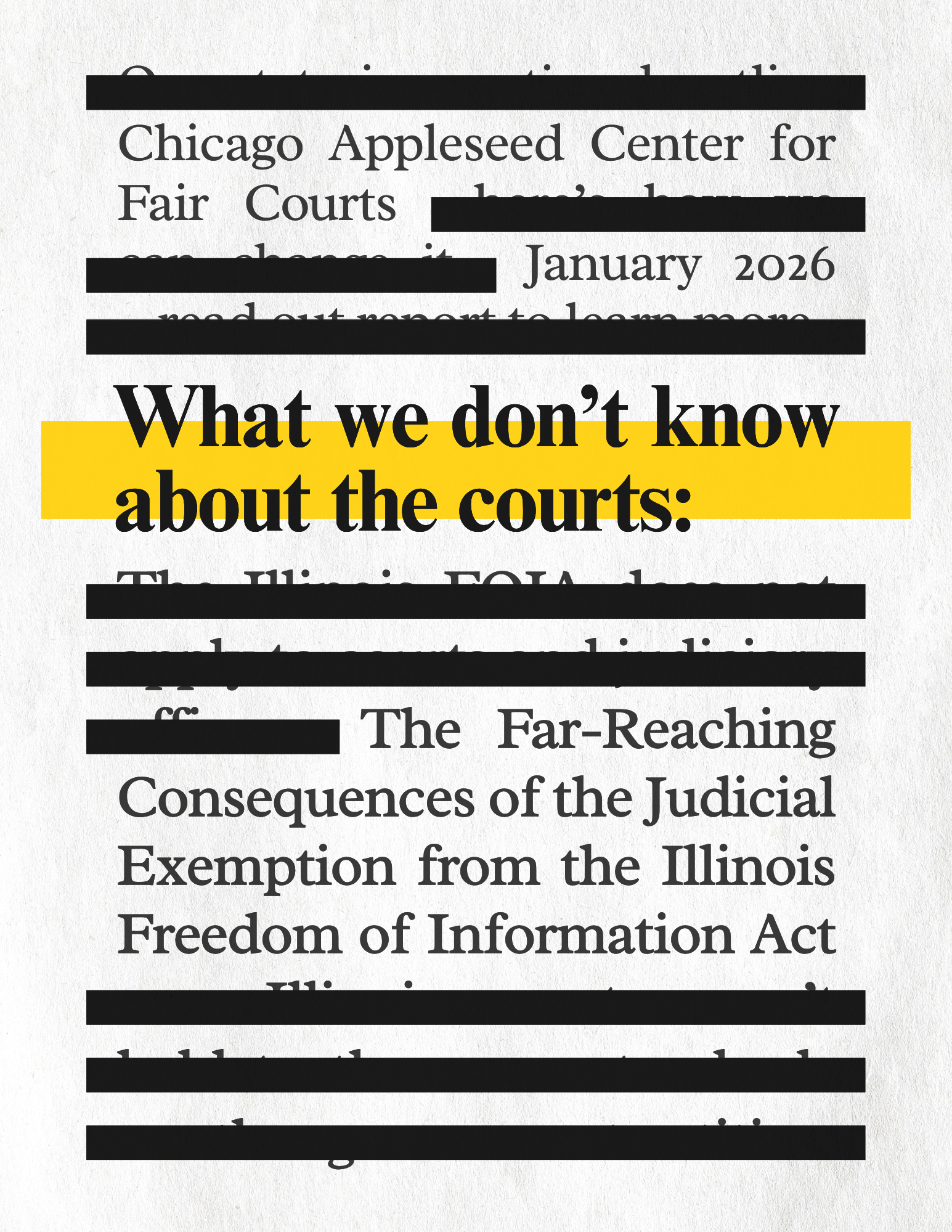
What we don’t know about the courts: The Far-Reaching Consequences of the Judicial Exemption to Illinois’ FOIA | January 2026
Illinois’ FOIA, which requires “public bodies” to respond to any written request for information from the public within five days, was implemented in 1984—but because the law doesn’t explicitly name the judicial branch, an appellate court decided in 1995 that FOIA doesn’t apply to the courts or related entities. This means that certain elected officials (like most judges and the Clerks of the Circuit Courts) and their agencies are not held to the same level of transparency or accountability as other government officials.
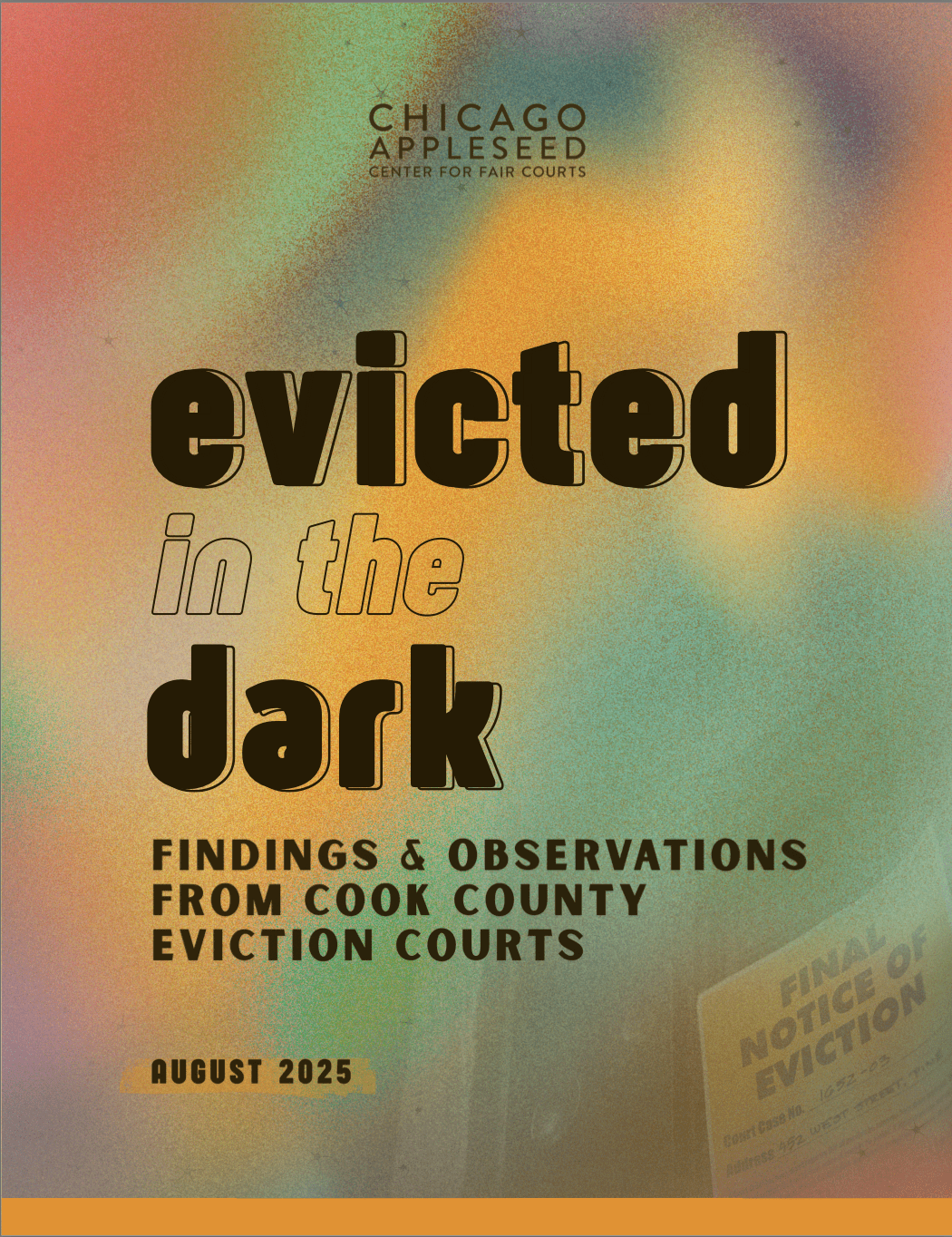
Evicted in the Dark: Findings & Observations from Cook County’s Eviction Courts | August 2025
Eviction is an incredibly destabilizing experience, and most people being evicted are Black, female-presenting people with children who don’t have lawyers to represent them. To understand the full picture of evictions in Cook County, our volunteer court-watchers conducted two rounds of observations in virtual initial appearance eviction courtrooms for all six districts of the Circuit Court of Cook County between November 2024 and April 2025. Here’s what they saw.
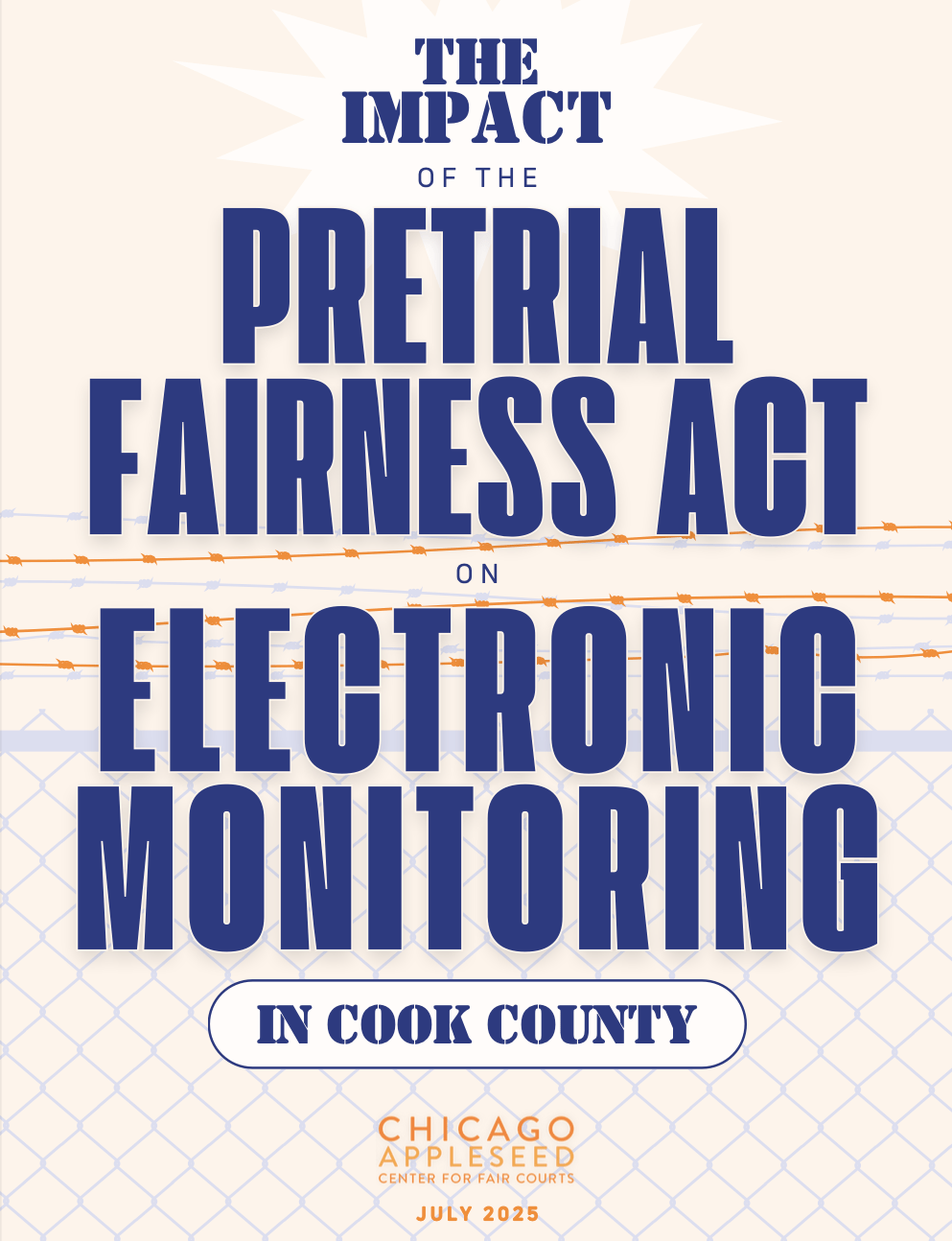
The Impact of the Pretrial Fairness Act on Electronic Monitoring in Cook County | August 2025
In this report, we evaluate and provide policy recommendations related to four of the five reforms to electronic monitoring passed in 2021 with the Pretrial Fairness Act, and in 2022 with its trailer bill. These include: higher standards for risk assessments relating to setting pretrial conditions and for charging people with escape, and guaranteed essential movement, sentencing credit, and 60-day reviews of EM conditions.

Punishing Fear: The Devastating Impact of the War on Gun Possession in Chicago | October 2024
Punishing Fear explains how the mounting public pressure to stop gun violence has ineffectively targeted survivors of violence who carry guns for protection. The report analyzes the political and social realities that have led to the hypercriminalization of gun possession in Chicago—the “War on Guns,” which parallels the historic War on Drugs and has similarly devastated Black and Brown communities.

When You’re a Hammer, Everything’s a Nail: Examining the “Progressive Prosecutor” Movement and Possibilities for Future Reform | March 2024
This report is a high-level examination of ideas behind the nationwide “progressive prosecutor” movement, culminating from over six years of research conducted by Chicago Appleseed Center for Fair Courts, the Chicago Council of Lawyers, and our various community partners.

Voting for the Clerk of the Cook County Circuit Court: Your Guide for the 2024 Primary | March 2024
The Clerk of the Circuit Court of Cook County has unique responsibilities that directly impact access to our courts and is in a position to create or remove many barriers to justice. The Court Clerk answers to a number of constituencies; in order to help these constituencies become better informed voters, Chicago Appleseed Center for Fair Courts has created this list of FAQs.

Restorative Justice, Community, and the Courts: An Analysis of the Impact, Benefits, and Elements “Constantly in Conflict” in Chicago’s Restorative Justice Community Courts | February 2024
This report is an exploratory study of the three Restorative Justice Community Courts (RJCCs) administered by the Circuit Court of Cook County in Chicago, located in the Avondale, Englewood, and North Lawndale neighborhoods.

I Don’t Know Why I’m Here: Observations from Cook County’s Civil Asset Forfeiture Courtrooms | April 2023
Civil asset forfeiture is a confusing, costly, and lengthy process that is ineffective at deterring crime, does not have an impact on crime rates, and disproportionately harms lower-income people of color. In this report, we describe the harms experienced by self-represented litigants in Cook County’s CAF courtrooms and advocate for the end of civil asset forfeiture in the state of Illinois.

One Size Doesn’t Fit All: A review of Post-Plea Problem-Solving Courts in Cook County | March 2023
This report examines the various challenges that influence the reality of the Cook County problem-solving courts, faced both by the courts themselves and their participants. It seeks to demonstrate the impact of these courts and the experiences of individuals struggling with their mental health and/or substance use, or facing charges related to substance use, drug possession, and mental health, among others.

Fear and Silence: How Culture, Policy, and the “Win at all Costs” Mentality Allows Police Testilying to Thrive – Finds and Recommendations to Address Policy Perjury and False Reporting in Chicago & Cook County, Illinois | January 2023
For this report, we interviewed attorneys, researchers, journalists, community organizers, and directly impacted people to identify how false reports and police perjury impact the Circuit Court of Cook County and the people it serves.

Reducing Barriers to Recovery: Shifting Low-Level Drug Possession From Felonies to Misdemeanors in Illinois | November 2022
This report is a joint effort by Chicago Appleseed, the ACLU of Illinois, the Cook County Department of Public Health, and the Illinois Justice Project to take a holistic, comprehensive approach to decreasing penalties for drug possession, so that people who use drugs can find a path to live happy, productive lives and avoid the catastrophic consequences of felony prosecution and conviction.

State of Injustice: A Community Review of Bond Courts in Illinois | November 2022
In order to understand how the state’s bond courts function before the implementation of the Pretrial Fairness Act in September 2023, Chicago Appleseed, as part of the Illinois Network for Pretrial Justice, conducted a court-watching project in seven courthouses between June and September of 2022. Our court-watchers observed bond courts at the Circuit Courthouses in Champaign, DuPage, Kane, McLean, Peoria, Sangamon, and Winnebago Counties.

Cages Without Bars: Pretrial Electronic Monitoring Across the United States | September 2022
This report responds to the gap in critical research on pretrial electronic monitoring. This report was authored by Chicago Appleseed, Shriver Center on Poverty Law, and MediaJustice and was created with support from the John D. and Catherine T. MacArthur Foundation as part of the Safety and Justice Challenge, which seeks to reduce over-incarceration by changing the way America thinks about and uses jails.

Electronic Monitoring Review – Cook County Illinois | September 2022
In May 2020, the Cook County Justice Advisory Council asked CGL Companies and Chicago Appleseed to provide technical assistance in a review of the use of electronic monitoring in the County criminal legal system. This report examines operations of the County’s EM programs and the perspectives of community-based service providers who interact with people assigned to electronic monitoring, focusing on employment, education, housing, movement, effects on family and community engagement, healthcare, and the impacts of COVID-19.

Progressive Promises: Results of a Reform Prosecutor in Cook County | September 2022
Since Kim Foxx took office in Cook County, Chicago Appleseed Center for Fair Courts, the Chicago Council of Lawyers, The People’s Lobby, and Reclaim Chicago have monitored the policies and practices of the Cook County State’s Attorney’s Office (CCSAO) in order to evaluate how State’s Attorney Foxx’s administration has lived up to her campaign promises. This report is the ninth in our series and discusses the general understanding of the role of “progressive” prosecutors.

Slipping Through the Cracks: An Evaluation of Cook County’s Domestic Violence Division in Chicago | August 2022
For this report, we interviewed over 30 Cook County judges and social service practitioners and completed 180 courtroom observations in order to identify common themes that suggest the courthouse located at 555 West Harrison in Chicago has a variety of necessary but under- funded support services and a wide range in the quality of judges and court staff, which systematically perpetuates institutional racism, classism, and sexism by creating inaccessible courts.

New Directions for the Clerk of the Cook County Circuit Court – First Year Progress Report | February 2022
Prior to the November 2020 General Election, Chicago Appleseed Center for Fair Courts, the Chicago Council of Lawyers and the Civic Federation offered joint recommendations for the next Clerk to improve management, technology, transparency and public access issues in the Office of the Circuit Court Clerk through a transition report. This progress report examines Cook County Circuit Court Clerk Iris Martinez’s first full year in office—December 1, 2020 through November 30, 2021.

10 Facts About Pretrial Electronic Monitoring in Cook County | September 2021
There are two pretrial electronic monitoring programs in Cook County: The larger of the two is run by the Cook County Sheriff’s Office and the other is the Home Confinement Unit run by the Adult Probation Department’s Pretrial Services Division, under the Office of the Chief Judge This report catalogs ten basic facts about the Cook County Sheriff’s Electronic Monitoring Program to help readers understand the breadth of this program, who exactly is affected, and whether it is worth the millions of dollars spent each year to maintain it.

“Solutions Rather than Obstacles.” An Evaluation of the Hearing Officer Program in the Domestic Relations Division of the Cook County Circuit Court | August 2021
From February to June 2021, Chicago Appleseed Center for Fair Courts undertook a systemic evaluation of the Hearing Officer Program of the Domestic Relations Division in Cook County. The purpose of this review is to evaluate the efficacy of the Hearing Officer Program in year four of its operation, understand where disparities in representation and access may still exist, and offer potential avenues for improvement.

Nationwide Jurisdictional Analysis of the “Right to Communicate” | July 2021
Governor JB Pritzker signed the Safety Accountability Fairness and Equity – Today (SAFE-T) Act in February of 2021. Among the many police and criminal legal system provisions in the law, it solidified the right to communicate for all people arrested in Illinois. We conducted a nationwide analysis of the right to communicate in each US state based on the combination of each states’ statutes, case law, informal programs, and statements from regional attorneys.

Decarcerating Cook County: Use of Diversion Programs for Low-Level, “Non-Violent” Felonies | March 2021
Since Kim Foxx took office in Cook County, Chicago Appleseed, the Chicago Council of Lawyers, The People’s Lobby, and Reclaim Chicago have monitored the policies and practices of the Cook County State’s Attorney’s Office in order to evaluate how State’s Attorney Foxx’s administration has lived up to her campaign promises. This report is the eighth in our series and discusses the use of diversion and decarceration.

Protecting Public Health through Decarceration: Holding Cook County’s Criminal Courts Accountable During the COVID-19 Pandemic | September 2020
From March to May, 2020, more than 500 people incarcerated in Cook County Jail contracted COVID-19 and seven lost their lives; more than 400 Sheriff’s employees tested positive for COVID-19 and three died. In this report, Chicago Appleseed, as part of the Coalition to End Money Bond, examines how Cook County Jail quickly became the top coronavirus hotspot in the country.

New Directions for the Office of the Clerk of the Cook County Circuit Court: Recommendations for Planning and Transitioning to New Leadership | September 2020
To prepare for the first new Clerk of the Circuit Court of Cook County in decades, Chicago Appleseed Center for Fair Courts, the Chicago Council of Lawyers, and the Civic Federation released a transition report with recommendations for the new Court Clerk to better serve the public and users of the court system in the areas of management, technology, data transparency, accessibility, ethics, oversight, and budgeting.

Cook County E-Court: Evaluating the Circuit Court’s Response to the COVID-19 Pandemic and Looking Toward the Future | August 2020
In light of the due process and access to justice challenges facing our courts during the COVID-19 pandemic, this report breaks down general best practices, legal research, and especially important anonymous survey responses to help the Circuit Court of Cook County as it navigates an unprecedented public health crisis. The most common observations provided discussed the Circuit Court of Cook County’s unpreparedness and inadequate technology to deal with an unforeseen disaster of this kind.
Court Costs, Fines, and Fees are Bad Policy: Recommendations for Illinois Legislators | July 2020
The phrase “monetary sanctions” is an umbrella term for describes a broad range of fines, fees, and court costs that regularly result in cycles of debt and poverty. In light of the implementation of the Criminal & Traffic Assessments Act (CTAA) in 2019, this report explores the rise of monetary sanctions as common practice in the criminal legal system and evaluates their utility as policy tools.
Data Shows Major Decrease in Felony Charges, Incarceration Rates for Black and Latin[e] Residents in Cook County since 2017 | February 2020
Since Kim Foxx took office in Cook County, Chicago Appleseed, the Chicago Council of Lawyers, The People’s Lobby, and Reclaim Chicago have monitored the policies and practices of the Cook County State’s Attorney’s Office in order to evaluate how State’s Attorney Foxx’s administration has lived up to her campaign promises. This report is the seventh in our series and discusses decreases in charging and incarceration rates.